
Ever thought if the lowest interest rate is the cheapest for your dream home? Many buyers just look at rates. But, mortgage affordability is about more than just rates.
Choosing between FHA vs Conventional Loans is a big deal. It depends on your savings, credit, and goals for the future.
A good mortgage comparison looks at down payments, insurance, and closing costs. You need to check these home loan options well to keep your money safe.
Legit Calc offers free online tools to help. These tools let you figure out monthly payments and compare loans easily.
Key Takeaways
- Remember, the lowest interest rate isn’t always the cheapest.
- Check your credit score and savings before picking a mortgage.
- Think about how mortgage insurance affects your budget over time.
- Use online calculators to see how much you’ll save in the long run.
- Compare closing costs to find the real cost of buying a home.
Understanding the Basics of FHA Loans
If you want to buy your first home, learning about FHA loans is key. An FHA mortgage is a loan from a bank or credit union. But, it’s backed by the Federal Housing Administration. This makes it easier for people to get loans who might not qualify otherwise.
What Are FHA Loans?
FHA loans help people own homes by making it easier to start. The FHA’s insurance lets lenders work with people who have less credit or smaller down payments. Remember, even with FHA insurance, you must meet your lender’s criteria.
Eligibility Requirements for FHA Loans
To qualify for an FHA loan, you need to meet certain requirements. You must live in the home as your main residence. Your credit score, debt-to-income ratio, and local loan limits also matter.
Lenders check for:
- A minimum credit score, often starting as low as 580 for a 3.5% down payment.
- Proof of steady employment and income to ensure you can manage your monthly payments.
- Property standards that ensure the home is safe, sound, and secure.
- Adherence to local loan limits which vary by county across the United States.
Benefits of FHA Loans
FHA loans offer lower down payments and more flexible credit scores. This helps many families buy homes sooner. Use home and mortgage calculators to plan your budget.
Choosing the right path for your future needs careful planning. FHA mortgages can help you build equity while keeping payments low. Always check your FHA eligibility with a licensed expert to make the best choice for your future.
Understanding the Basics of Conventional Loans
Starting your journey to own a home means learning about conventional mortgages. These loans are not insured by the FHA or other federal agencies. They need a more stable financial situation from the borrower.
What Are Conventional Loans?
A conventional mortgage is a flexible tool for your needs. You can pick from fixed-rate or adjustable-rate mortgages. Fixed rates stay the same, while adjustable rates may start lower.
These loans are either conforming or jumbo. Conforming loans meet size limits set by Fannie Mae and Freddie Mac. Jumbo loans are for more expensive homes.
Choosing the right loan helps fit your budget and plans. If your finances change, you can refinance to adjust your payments.
Eligibility Requirements for Conventional Loans
Conventional loans need more financial preparation than others. Lenders look for a good credit score. This shows you can handle debt well.
You also need to show steady income and enough money for a down payment. Your debt-to-income ratio is important too. It should be low enough for lenders to approve you.
The property must also pass an appraisal. This checks its value and condition.
Benefits of Conventional Loans
Conventional loans have big benefits. One is the chance to remove private mortgage insurance (PMI) once you have enough equity. This saves a lot of money over time.
When comparing conventional loan vs FHA loan pros and cons, conventional loans offer more freedom. They might be stricter at first, but they offer more flexibility and savings in the long run.
| Feature | Conventional Loan | FHA Loan |
|---|---|---|
| Insurance | PMI (Removable) | MIP (Life of Loan) |
| Credit Score | Higher Standards | More Flexible |
| Down Payment | As low as 3% | 3.5% |
| Property Types | Broad Flexibility | Stricter Standards |
Key Differences Between FHA and Conventional Loans
Choosing the right loan is key. A FHA versus conventional comparison helps. Both paths lead to owning a home. But, they differ in how they see your risk and your future costs.
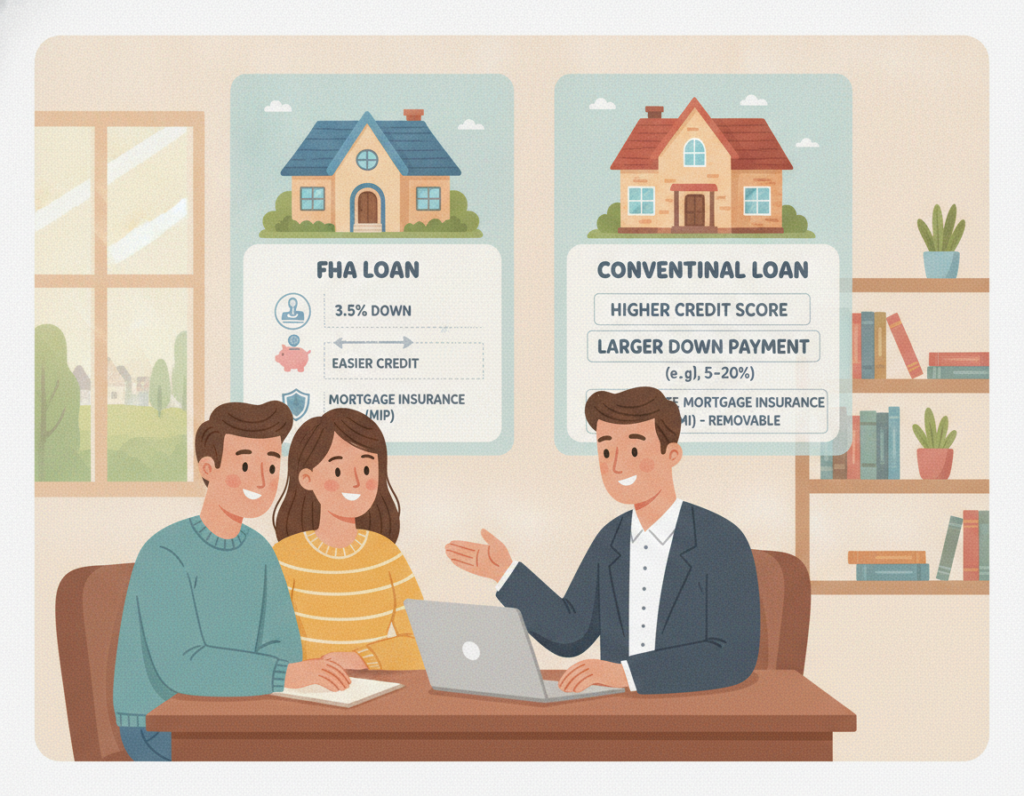
Down Payment Requirements
Conventional loans might need less down, like 3% for first-timers. FHA loans ask for 3.5% down if your credit is good.
Think about more than just the down payment. Use Legit Calc to see your monthly costs. A smaller down payment might mean higher rates or more insurance.
Credit Score Expectations
FHA loans are easier to get if your credit is low. The government backs these loans, making lenders more lenient.
Conventional loans need a higher credit score for the best rates. If your credit is strong, a conventional loan might be better.
Mortgage Insurance Costs
Knowing about mortgage insurance requirements is crucial. Conventional loans have Private Mortgage Insurance (PMI). You can drop PMI when you own 20% of your home.
FHA loans have Mortgage Insurance Premiums (MIP). This includes an upfront fee and an annual fee. The debate is between PMI versus MIP. FHA insurance stays for the loan’s life if you put down less than 10%.
| Feature | FHA Loan | Conventional Loan |
|---|---|---|
| Minimum Down Payment | 3.5% | 3% to 5% |
| Credit Score Needs | More flexible | Higher standards |
| Insurance Type | MIP | PMI |
| Insurance Removal | Often permanent | Removable at 20% equity |
Costs Associated with FHA vs Conventional Loans
When you look at home loans, the price is just the start. The real cost of borrowing includes many fees and insurance needs. These can change your monthly payments a lot.
Upfront and Ongoing Fees
FHA loans have special insurance needs that differ from conventional loans. You need to pay a 1.75% upfront mortgage insurance premium. This premium is added to your loan balance.
FHA mortgage insurance costs stay with you for the loan’s life in many cases. On the other hand, conventional PMI costs are needed only if you put down less than 20% of the home’s price. Once you have enough equity, you can often stop paying private mortgage insurance on a conventional loan.
Closing Costs Comparison
Every loan type has closing costs at the end. These mortgage closing costs include origination fees, appraisal costs, title services, and prepaid items like property taxes or homeowners insurance.
The cost varies based on:
- Your lender’s fees.
- The property’s location.
- The loan amount you ask for.
- The transaction’s complexity.
To understand your financial commitment, use Legit Calc’s free online calculators. These tools help you estimate your cash-to-close and total repayment with accuracy.
Interest Rate Differences
Many focus on FHA vs Conventional loan rates when choosing a mortgage. FHA loans might have lower interest rates, but the insurance premiums can make your monthly payments higher.
| Cost Factor | FHA Loan | Conventional Loan |
|---|---|---|
| Upfront Premium | 1.75% (Financed) | None |
| Ongoing Insurance | Annual MIP | PMI (Cancelable) |
| Rate Sensitivity | Lower Base Rate | Market Driven |
It’s important to look at the Annual Percentage Rate (APR), not just the interest rate. The APR shows the total cost of credit, including fees and insurance. By using reliable calculators, you can compare these figures side-by-side. This helps you choose the best loan for your long-term goals.
Qualifying for FHA and Conventional Loans
Getting a home loan means you need to know how lenders check your money. Whether it’s an FHA or a conventional loan, you must show you can handle money well. Preparation is the key to a smooth home buying journey.
Documentation Requirements
To start your mortgage qualification, you need many financial papers. Lenders want to see your income, money, and credit score. Here’s what you’ll need:
- Recent pay stubs covering at least the last 30 days.
- W-2 forms and federal tax returns from the past two years.
- Bank statements for all accounts over the last two to three months.
- Valid government-issued identification.
- Written explanations for any significant credit events or gaps in employment.
Lenders check these papers to make sure you’re employed and have the right money. Having your papers ready early can make things faster.
Debt-to-Income Ratio Considerations
Your debt-to-income ratio (DTI) is very important to lenders. It shows how much you can borrow. FHA loans might be more flexible, but conventional loans are stricter.
“The most successful borrowers are those who understand their financial boundaries before they ever step foot in a lender’s office.”
Before applying, use Legit Calc’s free online calculators to estimate your DTI. Knowing this helps you find the right home. Here’s a table showing the main differences:
| Qualification Factor | FHA Loan Focus | Conventional Loan Focus |
|---|---|---|
| Documentation | Standardized but flexible | Strict and comprehensive |
| DTI Threshold | Allows higher ratios | Lower, stricter limits |
| Credit History | Accepts past credit events | Emphasizes high scores |
| Employment | Focus on stability | Focus on longevity |
Your choice between FHA and conventional loans depends on your money situation. Keep your records clean and watch your DTI. This makes you a strong candidate for either loan.
Impact of FHA and Conventional Loans on First-Time Homebuyers
When you start to buy a home, you must choose between FHA and conventional loans. Picking the right first-time homebuyer mortgage is very important. It affects your money for a long time. Knowing how these loans fit with your money now and your future plans is key.

Advantages for First-Time Buyers
An FHA first-time buyer loan can help you own a home even if you don’t have a lot of money saved. These loans let you put down less money. This means you can keep more money for other things you need.
Having less money down can help you save for emergencies. Use Legit Calc to check if a small down payment works for you. This tool helps you see if your monthly payments fit your budget.
Potential Challenges to Consider
But, there are also challenges with government-backed loans. FHA loans have mortgage insurance that lasts forever if you put down less than ten percent. This can make your loan more expensive over time compared to other loans.
FHA loans also have strict rules about the condition of the home. If a home needs a lot of repairs, it might not qualify for a loan. You also need to know about loan limits in your area. These limits can affect how much you can borrow.
| Feature | FHA Loan | Conventional Loan |
|---|---|---|
| Down Payment | As low as 3.5% | As low as 3% |
| Mortgage Insurance | Required for life of loan | Removable after 20% equity |
| Credit Flexibility | More forgiving | Higher score preferred |
| Property Standards | Strict requirements | Standard appraisal |
Refinancing Options for FHA and Conventional Loans
Knowing your refinancing options is key, whether you have an FHA or conventional loan. Your financial situation can change, making your mortgage terms outdated. Choosing wisely can lead to better terms and more money in your pocket.
FHA Streamline Refinance
The FHA streamline refinance makes things easy for FHA borrowers. It needs less paperwork and is faster than a regular refinance. It’s great for lowering your monthly payment without a full credit check or appraisal.
Remember, each lender has its own rules. Make sure you’re eligible for the potential payment improvement. You might also look into switching to a conventional loan to drop mortgage insurance premiums.
Conventional Loan Refinancing Strategies
With a conventional refinance, you can pick from many strategies. Many aim to remove private mortgage insurance (PMI) when they have enough equity. Others switch to a fixed-rate loan for stable payments.
Shortening your loan term can also save you money. Always check refinance mortgage rates to time it right. Before you start, figure out your refinance closing costs to see if you’ll save money.
| Refinancing Goal | Primary Benefit | Key Consideration |
|---|---|---|
| Lower Monthly Payment | Increased cash flow | Break-even point |
| Remove PMI | Lower total payment | Home equity level |
| Shorten Loan Term | Interest savings | Higher monthly cost |
| Switch to Fixed Rate | Payment predictability | Current market rates |
Use Legit Calc’s free online calculators to make a smart choice. They compare your current loan to new offers. Make sure the long-term benefits are worth the upfront costs.
Long-Term Financial Implications
Choosing a mortgage affects your money for a long time. The excitement of buying a home is big at first. But, the real impact of your loan choice shows up over years.
Thinking about your long-term plan helps keep your housing costs stable. This is important as your life changes.
Impact on Your Mortgage Payments
Your monthly budget depends a lot on your mortgage payments. When looking at options, think about how FHA vs Conventional loan limits affect your choices. These limits can make a big difference in what you can afford.
Also, think about the total mortgage interest you’ll pay over time. Conventional loans might let you drop private mortgage insurance sooner. This can lower your monthly payments a lot.
But, FHA loans might keep you paying mortgage insurance for the whole loan. This affects your money over time.
Potential for Equity Building
Building equity in your home is key to wealth. You can speed this up by paying extra or choosing a shorter loan. This way, you pay less interest and own your home sooner.
Also, as your home value goes up, so does your equity. This gives you more money for the future. Use tools like Legit Calc to see how this works for you.
| Factor | FHA Loan | Conventional Loan |
|---|---|---|
| Insurance Duration | Usually life of loan | Removable at 20% equity |
| Interest Rate | Often lower initially | Market-dependent |
| Equity Growth | Slower due to fees | Faster with early payoff |
| Payment Stability | Fixed | Fixed or Adjustable |
Knowing about long-term mortgage costs helps you make a smart choice. Use a reliable calculator to see how your choice affects your future.
Making the Right Choice for Your Home Purchase
Choosing the right mortgage is important. You need to look at your money situation. This includes your credit score, how much cash you have, and what you want for your future home.
Knowing how to pick between FHA and conventional loans helps. It lets you match your debt plan with your monthly budget.
Key Decision Drivers
Your choice of mortgage depends on several things. FHA loans are good for those needing lower credit scores or smaller down payments. Conventional loans might be better if you want more flexibility or to remove private mortgage insurance later.
Don’t just look at interest rates. Total costs over the loan’s life show how affordable it is. Compare these to find the mortgage that fits your goals, not just the minimum down payment.
Professional Support
Use online calculators like Legit Calc to see different payment plans. These tools are a good first step. Then, talk to a mortgage lender to check your findings.
A mortgage expert can check your debt-to-income ratio and property type. They make sure you get the best terms. Working with an expert helps keep your finances stable for years.