Beyond the Estimate: Calculating Your HECM Reverse Mortgage
For many retirees, the “Retirement Equity Puzzle” represents a structural flaw in traditional retirement planning. We often obsess over portfolio volatility and liquid assets while ignoring our largest store of stagnant capital: home equity. A Home Equity Conversion Mortgage (HECM) calculator is far more than a simple estimator; it is a strategic financial crystal ball that can reveal how to activate your home’s value for multi-decade security.
1. Your Age is More Than a Number—It’s a Multiplier
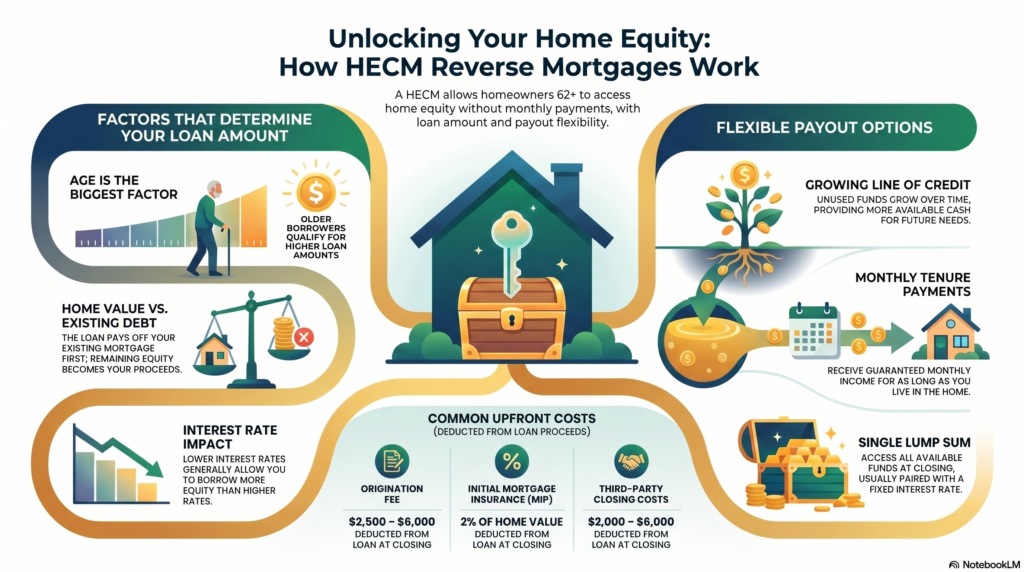
In the world of HECM loans, age serves as a primary driver of borrowing power. Unlike traditional lending, where a longer life expectancy might be viewed as a risk, the HECM system uses an actuarial advantage to reward older participants. It is important to remember that for couples, this “multiplier” is anchored to the age of the youngest spouse on the title.
“The relationship between age and loan amount follows FHA’s principal limit factor tables. These tables show that lending percentages increase as borrowers age. A 62-year-old might access 50% of their home value, while a 75-year-old could potentially access 60% or more.”
This structure creates a unique financial environment in which time is an ally of your borrowing power, not just a liability. While younger seniors (62–69) may benefit from more years of potential credit line growth, older borrowers gain immediate access to a higher Principal Limit Factor, making the HECM a product that rewards those who wait.
2. The Mandatory “Clean Slate” Requirement
When a calculator asks for your “Existing Mortgage Balance,” it is identifying the first hurdle to your financial freedom. A fundamental requirement of the HECM program is that the proceeds be used first to pay off all existing debt tied to the property. This “clean slate” ensures the FHA-insured loan holds the primary position on the home’s title.
The Mandatory Payoff List:
- Existing primary mortgage balances
- Outstanding property liens
- Delinquent property taxes or homeowners’ insurance
As a consumer advocate, I view this requirement not as a cost, but as a primary wealth-preservation benefit. By clearing these debts, you effectively eliminate mandatory monthly mortgage payments. This immediately pivots your cash flow from a defensive “debt-servicing” posture to an offensive “lifestyle-funding” strategy.
3. The “Magic” of the Growing Line of Credit
One of the most powerful “secrets” hidden in the calculator is the Line of Credit (LOC) projection. Unlike a traditional Home Equity Line of Credit (HELOC), which can be frozen or canceled by the bank during economic downturns, a HECM LOC is guaranteed to remain available as long as you meet your loan obligations. Even more remarkably, the unused portion of this line grows automatically over time.
“Unused portions of your credit line grow over time at the same rate as your loan interest rate. The calculator can project how your credit line expands over five, ten, or fifteen years.”
This growth feature makes the HECM a superior emergency fund strategy compared to any traditional banking product. Because your borrowing power expands at the same rate as the interest on the loan, you are effectively protected against inflation and rising healthcare costs, with your available funds increasing the longer you leave them untouched.

4. The Non-Recourse Shield—A Safety Net for Your Heirs
A major source of anxiety for retirees is the fear of leaving their children with a “debt bomb” if the home’s value drops. HECM calculators help project future balances and also reflect the Non-Recourse Guarantee. This protection ensures that the borrower and their heirs will never owe more than the home’s appraised value at the time of sale, regardless of how much interest has accumulated.
Protecting the Next Generation:
- Market Crash Protection: If the loan balance grows to exceed the home’s value, FHA insurance covers the shortfall.
- The 95% Rule for Heirs: If your heirs wish to keep the home, they have the right to settle the debt for 95% of the home’s current appraised value, even if the loan balance is much higher.
This distinction between Loan Balance and Home Value is vital for estate planning. It mitigates the risk of a housing market crash for the next generation, ensuring the debt stays with the property, not the family.
5. The “Net” vs. “Gross” Reality Check
It is critical to distinguish between the “Principal Limit” and the “Net Available Proceeds.” The Principal Limit is the gross amount the FHA allows you to borrow, but the amount you actually receive is reduced by mandatory setup costs. A high-quality calculator will break these down to prevent “sticker shock” during the official application.
Major Deductions to Expect:
- Origination Fees: These are capped at $2,500 for homes valued at $200,000 or less and can go up to $6,000 for higher-value properties.
- Initial Mortgage Insurance Premium (MIP): This is set at 2% of the home’s appraised value, not 2% of the loan amount.
- Closing Costs: Standard fees for appraisals, title insurance, and recording.
Understanding these costs is the difference between an “educational estimate” and an “official quote.” As a consultant, I advise viewing these fees as a long-term investment in your retirement stability. Managing these expectations early allows you to use the HECM as a strategic tool rather than a “quick cash” solution.

Click here to access the HECM Reverse Mortgage Blueprint
Conclusion: Looking Toward an Equity-Backed Future
The data provided by a HECM calculator is more than just a set of numbers; it is a roadmap for financial empowerment. By mastering the nuances of age multipliers, guaranteed credit line growth, and non-recourse protections, you can transition from being a passive homeowner to a strategic wealth manager.
As you look at your retirement roadmap, ask yourself this: Is your home equity a static asset, or a dynamic tool waiting to be leveraged for your retirement security?